

Physiotherapy or Occupational Therapy: Which One Do You Actually Need?
One rebuilds what the body can do. The other changes what the day demands of it. Knowing which one you need saves time.
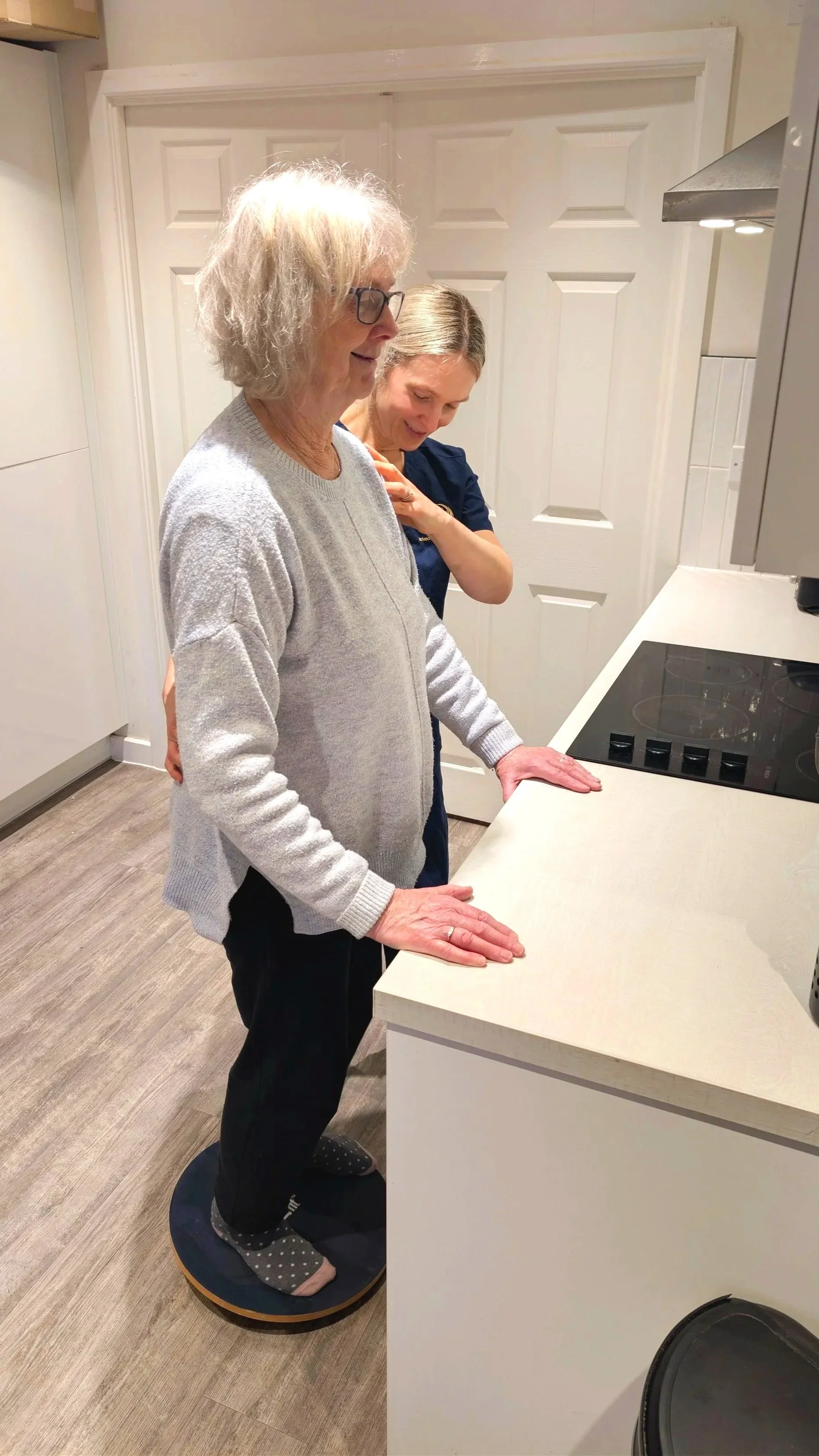
Someone at the hospital mentioned occupational therapy. The GP said physiotherapy. A friend said you want both. And nobody explained the difference, so you are now trying to choose a service you cannot describe.
Physiotherapy changes what the body can do. Strength, balance, walking, movement, pain. Occupational therapy changes what the day demands of the body. The tasks, the equipment, the home, the routine.
The short version
- Choose physiotherapy when the problem is strength, balance, walking, movement or pain.
- Choose occupational therapy when the problem is washing, dressing, the stairs, the chair, the kitchen or the equipment.
- Both professions are HCPC-registered, and you can go to either privately without a GP referral.
- If you cannot tell, start with whichever problem is causing the most trouble today. A good assessment will redirect you if needed.
- Some people need both. They do not have to happen at the same time.
What a physiotherapist does
Physiotherapy helps restore movement and function when someone is affected by injury, illness or disability.1 With older adults that usually means:
- Rebuilding leg and arm strength after illness, surgery or a hospital stay
- Balance training and falls prevention
- Walking — distance, quality, confidence, and whether a stick or frame is right
- Rehabilitation after hip replacement, knee replacement or a fracture
- Neurological rehabilitation after stroke, or for Parkinson's disease and other conditions
- Pain management and hands-on treatment for musculoskeletal (MSK) problems
Physiotherapists are regulated by the Health and Care Professions Council (HCPC), and their professional body is the Chartered Society of Physiotherapy.1 The core tool is progressive exercise: specific movements, done regularly, made harder as the person improves. A physiotherapist assesses what has been lost, works out how much of it is recoverable, and builds a programme to get it back.
What an occupational therapist does
"Occupation" here does not mean a job. It means any activity you need, want or like to do — washing, eating, cooking, getting out, seeing people.2 Occupational therapists focus on the activities that make up a day and whether someone can still do them. Their professional body is the Royal College of Occupational Therapists, and they are also regulated by the HCPC.
- Assessing the home for hazards, access and layout
- Equipment — rails, raised toilet seats, bath boards, perching stools, bed levers
- Seating and posture, including specialist chairs and wheelchair assessment
- Washing, dressing, cooking and other daily tasks — finding a way that works
- Fatigue management and pacing for long-term conditions
- Supporting people living with dementia to stay independent and safe at home
- Advising family and carers on safe technique
An occupational therapist starts from the task rather than the body. If someone cannot get out of the bath, the physiotherapy question is whether their strength can be improved; the occupational therapy question is whether the bath is the right place for them to be washing at all.
One asks "can we make her stronger?" The other asks "does this actually need to be this hard?"
Which one do you need? A rough guide
| The problem | Usually starts with |
|---|---|
| Getting weaker, unsteady on their feet | Physiotherapy |
| Falling, or afraid of falling | Physiotherapy — often with occupational therapy for the home |
| Struggling to get out of a chair or off the toilet | Either — strength or seat height, often both |
| Can't manage the stairs | Physiotherapy first, occupational therapy if it isn't recoverable |
| Can't wash or dress independently | Occupational therapy |
| Recovering after hip or knee replacement | Physiotherapy |
| Home feels unsafe or unmanageable | Occupational therapy |
| Pain limiting movement | Physiotherapy |
| Wheelchair or specialist seating needed | Occupational therapy |
| Carer struggling with moving and handling | Occupational therapy |
This is a guide, not a rule. Plenty of situations sit in both columns, and the honest answer is that a proper assessment sorts it out faster than a decision made in advance.
How the two work together
The clearest example is falls. For people at higher risk of falling, NICE recommends progressive strength and balance exercise and a home hazard assessment. The home assessment can be done by a suitably trained professional, and NICE sees an occupational therapist as the best person to do it.3 That is two professions tackling two halves of one problem. There is more on this in what actually keeps you steady at home.
Similarly, after a hospital stay, physiotherapy rebuilds the strength lost to bed rest while occupational therapy makes sure the home is not undoing that work by forcing someone into a chair they cannot get out of.
In practice, most people need one profession rather than both. Where both would help, they usually run in sequence rather than side by side — and the important thing is that the two therapists are talking to each other, so the exercise programme and the equipment plan point the same way.
What about the other professions you might hear about?
Reablement workers and rehabilitation assistants support people to practise daily activities, often as part of a short NHS or council service, usually working to a plan set by a qualified therapist.
Speech and language therapists deal with swallowing and communication — important after stroke and in some neurological conditions.
Podiatrists handle foot problems, which matter more for falls than people expect.
If you are not sure who you need, that is fine. It is a normal question, and we will tell you honestly if the answer is someone other than us.
How we can help
Salveo Forma is a local team of HCPC-registered physiotherapists and occupational therapists, and we come to you — at home, in a care home, or in a nursing home — across Dorset, Hampshire, Wiltshire, Somerset, Bath and Bristol. Our therapists are experienced NHS clinicians, with 150+ years' combined experience.
You do not have to work out the answer yourself before you call. Describe what is going wrong and we will tell you which profession fits — including if the answer is that you do not need us yet.
Our occupational therapy is currently based in east Dorset, and we are actively recruiting occupational therapists for other areas. Most people need one profession or the other. Where both would help, we coordinate it within the same team rather than sending you off to arrange a second referral.
No GP referral needed. Same-week appointments are available, and for urgent needs we aim to visit within 24 hours where we have availability.
Call Salveo Forma on 07384 590177 for a free phone consultation with Debbie Richards, our Clinical Director.
Call Salveo Forma on 07384 590177Initial assessment £110 (60+ minutes). Follow-up visits from £55. Occupational therapy is charged at the same rates.
Common questions
What is the difference between physiotherapy and occupational therapy?
Physiotherapy improves what the body can do — strength, balance, walking, movement and pain. Occupational therapy changes what daily life demands of the body — the tasks, equipment, seating and home environment. Physiotherapy works on the person; occupational therapy adapts the activity and the surroundings.
Which does my elderly parent need?
If the problem is weakness, unsteadiness, walking or recovering after surgery, start with physiotherapy. If the problem is washing, dressing, the stairs, the chair, or a home that no longer works for them, start with occupational therapy. If it is both, either is a reasonable starting point — the assessment will sort it out.
Can you have both physiotherapy and occupational therapy?
Yes. Many people benefit from both, particularly after falls or a hospital stay. They usually run in sequence rather than at the same visit, and it matters that both therapists are working to the same plan.
Is an occupational therapist the same as a physiotherapist?
No. They are separate professions with separate training, though both are regulated by the HCPC. Occupational therapists specialise in daily activities, equipment and the environment; physiotherapists specialise in movement, strength and rehabilitation.
Do I need a GP referral for either?
No. You can contact a private physiotherapist or occupational therapist directly. Call Salveo Forma on 07384 590177 and we will arrange a home visit, usually within the same week.
What does HCPC-registered mean?
The Health and Care Professions Council is the UK regulator for both professions. Registration means the therapist holds an approved qualification, meets professional standards and can be checked on a public register.4 Anyone treating you should be HCPC-registered.
Which is better value if we can only afford one?
Neither is better in every case — it depends on what is going wrong. Describe the actual difficulty when you call Salveo Forma, and we will point you to the profession that fits, even if that means fewer visits.
References
- Chartered Society of Physiotherapy, What is physiotherapy? View source
- Royal College of Occupational Therapists, What is occupational therapy? View source
- National Institute for Health and Care Excellence (2025) Falls: assessment and prevention in older people and in people 50 and over at higher risk. NICE guideline NG249. View source
- Health and Care Professions Council, Check the register. View source
This article is general information and does not replace an individual assessment. Last reviewed: September 2026.